Veneration Gaps
Should we respect our elders?

On January 1, a peaceful Sunday evening, I was seated in the comfort of my sofa, passively engaging in a heated online war on Twitter dot com through strategically placed likes and retweets. An agent of chaos then appeared — my younger sister. She had an expression of general niceness, which set my internally developed and patented alarms blaring.
“I have a twenty-page report due tomorrow. Write it for me,” she said.
“???” I said outraged in a nonverbal language that is often commonly seen in siblings.
She replied with the topic of her report, completely and intentionally missing my point. The irony that the situation presented was compensation enough for me to oblige.
On one hand, like a typical school-goer, my sister had waited till the last moment to ask for help. It reminded me of my school days when I would remember something the night before a deadline that something was to be printed, well after all the nearby shops were shut for the night. Maybe some things don’t change after all, I thought.
On the other hand, seeing the format of the report, I was surprised to find out that children at school had to undertake surveys, interviews, attend conferences, workshops and write detailed reports. I realised that I had it too easy in school, which led me to agree with the title of the report, “Generation gaps do exist”.
Our survey comprised of 3 sections: gaps in use of technology, differences in approach to interpersonal relationships and contrast in personal belief systems. We received around 50 responses, distributed across the age groups of 0 to 18, 18 to 40, 40 to 60 and 60 and above. We arrived at the following conclusions:
As we move up the age groups, comfort with usage of technology declined.
As we move down the age groups, the level of belief in culture and tradition declined.
Almost all respondents reported to enjoy their interactions with people from other generations.
As we move up the age groups, it is more likely that one respects their elders’ wishes even if it means going against their own personal beliefs.
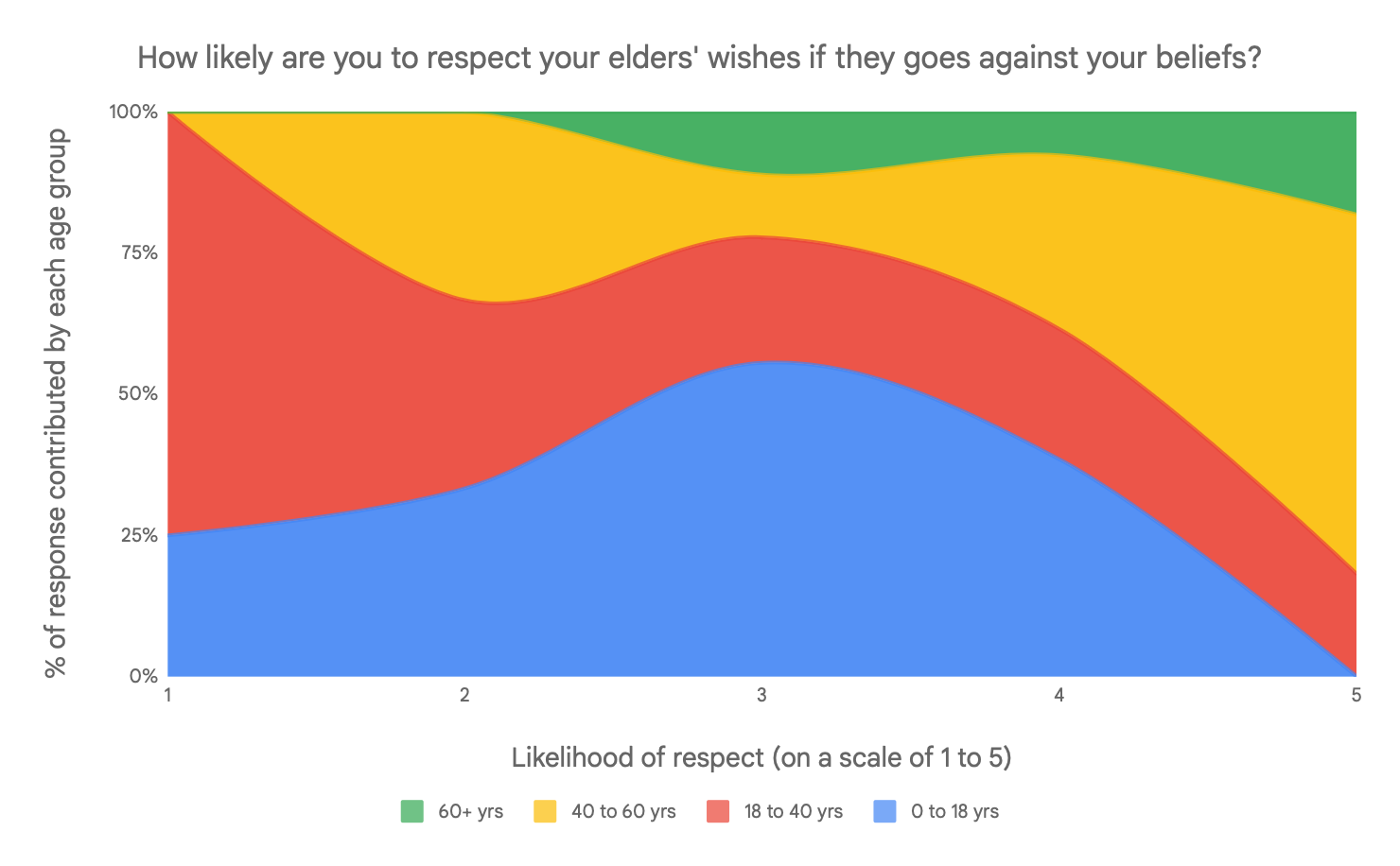
The final conclusion leads me to a digression from the report and to the main question of this piece — Should we respect our elders?
It sounds like a no-brainer to say that everyone must be respected irrespective of their age. But sometimes, no-brainers are no-brainers because they haven’t been given sufficient thought. I wanted to explore why this idealism does not translate to reality and understand why the notion of respecting elders for being elders seems more prevalent in the real world.
We asked the participants of the survey what they liked and disliked about the older generations. I was surprised to see that the answers didn't change across age groups. An 82-year old and a 16-year old had the same opinion about their elders — “We value their experience and good advice. But they are stubborn in their beliefs and refuse to change their views.”
What one values in their elders hasn’t changed — experience and wisdom. So, what is the cause for the decline in respect for elders relative to one’s personal beliefs?
My opinion is that reverence is a product of relevance and consensus.
Relevance plays a role in heightening the value of someone’s lived experience. Sure, I respect my grandfather for his struggles and the hardships he had to face in the factory and at home. But do I find it applicable in my life when nature of work, modes of communication and needs and wants in a relationship have all changed and drastically so? So, I tend to take his advice with an asterisk that it is not possible live life that way in today’s world.
Similarly, consensus in beliefs, or the lack thereof, plays a big discounting role in one’s respect for another. When our young brains took a few years and several angry tweets to unlearn and to adapt to new norms, why are we so quick to condemn our elders for their slowness in change? It does help to remember that they are out of reach and out of sync with the new age, but their advice is often discounted as useless, when it comes from someone with “messed up” beliefs.
After having formed this opinion, I flipped my point of view and asked myself some questions.
When I interact with the younger generation, do I expect their respect?
Is my expectation a function of me having respected my elders?
Or is it that I want my (relevant) expertise to be recognised and appreciated?
Fortunately, I will never know the answer to some of these harrowing questions because I plan on not leaving the younger generation, thanks to a wretched portrait in the attic.
I remember how your editors chased you 😂 Nice report!
Good report work😁😁